What an apostille does and which direction this guide covers
An apostille certifies the origin of a public signature, its official capacity and, where appropriate, the seal. It does not approve the document’s statements or guarantee that a foreign recipient accepts its format, age or translation. This guide covers South Dakota documents going abroad. For a foreign-issued record coming to South Dakota, obtain the apostille from the competent authority in that record’s country of origin when the Convention applies; mailing it to Pierre does not change its origin. [HCCH-01: Arts. 1-6; US-02.]
HCCH-01 source
US-02 source
Identify the destination before buying records
Get the receiving authority’s written list: country/territory, document names, original or certified copy, issue-age limits, language/translation and paper or electronic output. Check the HCCH status table for entry into force between the United States and the destination, extensions and objections; a signature or membership label alone is insufficient. A valid Convention apostille replaces diplomatic/consular legalization, so do not add an embassy step automatically. For a destination outside that relationship, establish the state authentication, any U.S. Department of State step and consular legalization sequence from current official destination instructions. [HCCH-01: Arts. 2-3, 9, 12; HCCH-02; SD-02: country field.]
HCCH-01 source
HCCH-02 source
SD-02 source
Choose the official signature before a notary
South Dakota SOS handles South Dakota state/local public documents and South Dakota notarial signatures. It cannot authenticate another state’s record or a federal record. Birth/death/marriage certificates, divorce decrees and court documents require certification by their issuing agency; SOS expressly excludes a notary’s true-copy certification for those categories. An affidavit or power of attorney instead needs the proper notarial act. A mixed packet may have several authorities. Do not use a notarized cover sheet to substitute for an issuer-certified vital, court or company record. [SD-01: Requirements and document table; US-02.]
SD-01 source
US-02 source
Order a certified vital record, not an informational record
Use the DOH Vital Records Request linked below. Select Certified, or Certified Photostatic only when the recipient needs information absent from the computer record and that format is available; do not select Informational. The ordinary certified record bears security paper, raised seal and issuing-agent signature. A hospital souvenir, website genealogy image or self-made photocopy is unsuitable. Fill in your own name/address/contact, qualifying relationship, the exact event/person details, copy type/count and signature. Vital records are restricted: registrant, current spouse, child, parent, guardian, specified next of kin, authorized/designated agent or a demonstrated personal/property right may qualify. Supply supporting authority if required. The designated-agent authorization on the reverse must be completed and notarized by the person appointing the agent. [SD-05: pp.1-2; SD-06: eligibility and copy types.]
SD-05 source
SD-06 source
Mail or collect the vital record first
For an ordinary mailed order, send the completed application, clear government photo-ID copy or the application notarization permitted by the mail instructions, and $15 per copy by check or money order payable to South Dakota Department of Health. Send to Vital Records, 221 W. Capitol Avenue, Pierre SD 57501. The form says an omitted copy-type choice causes rejection. If you lack government photo ID, the issuer lists two alternative identity documents; check SD-06 before sending sensitive copies. ID may be issued by the U.S. or the applicant’s country of residence. In-person orders are available at that State Office or a county Register of Deeds with application, fee and ID; cash/check/money order or card may be accepted, with a listed $2.50 card surcharge and local variation. Do not send an apostille request to DOH’s separate 600 East Capitol headquarters address. Receive the certified record, then prepare the separate SOS packet; no automatic forwarding is established here. [SD-04: Mail and In Person; SD-05: pp.1-2; SD-06; SD-07: payee.]
SD-06 source
SD-04 source
SD-05 source
SD-06 source
SD-07 source
Compare online vital-record ordering costs carefully
DOH identifies VitalChek as its only authorized third-party ordering vendor; use the link on SD-04, with a credit card in your name. The checked table totals one certificate by regular mail at $26.50 ($15+$6.50 vendor+$5 expedite) or UPS Next Day at $44.00 (adding $17.50); each extra record in the same order adds $15. The fee page calls the combined phone/internet charge $11.50, consistent with $6.50+$5 rather than another fee to add. These are vital-record charges, not the $25 apostille fee. Procurement times vary by office; no universal DOH completion period is published on the checked order page. Paid fast shipping does not prove same-day issuance. [SD-04: Online/Phone table; SD-07; SD-05: p.2.]
SD-04 source
SD-04 source
SD-07 source
SD-05 source
Distinguish marriage, divorce certificate and divorce decree
A DOH divorce certificate records the event; the court decree contains the actual court order. DOH says divorce certificates come only from the State Office, and divorce decrees only from the Clerk of Courts in the county of filing. Its general county Register of Deeds option therefore does not cover every record. Tribal marriage/divorce records must be obtained directly from the tribe; do not assume a tribal officer’s signature uses the ordinary South Dakota state apostille route without confirming the competent authority for that exact record. An unnamed birth record may require amendment before DOH can issue a certified copy. [SD-04: Before applying; SD-06: first-name question.]
SD-04 source
SD-06 source
Obtain a sealed court copy from the right clerk
Use UJS Court Finder through SD-08 to locate the Clerk of Courts holding the case. Give the case number, party names, exact filing/order and requested number of paper certified or authenticated copies; say it is for South Dakota SOS apostille use and needs the clerk’s original certification and court seal. Ask for the clerk’s page/certification charge, acceptable payment and return arrangements before ordering. UJS says copy costs vary by format and pages, and payment generally accompanies the request. Its July 2026 schedule lists authenticated copies at $15 and record searches at $20 per name; neither is a universal total for a multi-page certified-copy order. An eCourts summary or public terminal printout is not automatically a certified decree. Restricted/juvenile records require lawful access. No separate county-clerk authentication layer is prescribed for the ordinary properly certified court route in SD-01. [SD-08: court-copy question; SD-09: PDF p.3; SD-01: state/local documents.]
SD-08 source
SD-01 source
SD-08 source
SD-09 source
SD-01 source
Select the actual company record
A Certificate of Good Standing/Existence and a certified copy of articles or amendments are different products. The official portal asks for the Business ID and confirmation of the correct entity. Anyone may order, with exclusions for good-standing certificates for general partnerships, reserved/registered names and DBA business names. Good-standing online cost is $20; the fee schedule also lists a $35 paper certificate. Certified filed copies cost $15 plus $2 per page; select the specific filings rather than a plain search-result printout. Certified copies before November 14, 2016 are unavailable online and need the SOS office route. Portal cards include Visa, MasterCard, Discover and American Express; a PAD account is for existing prepaid-account holders, not required for an ordinary public request. [SD-10; SD-11; SD-12; SD-03: Miscellaneous Business Fees.]
SD-10 source
SD-11 source
SD-12 source
SD-03 source
Resolve company download versus original before payment
The portal can immediately download certified copies, while the apostille instructions require original seals/signatures. The checked sources do not expressly clear every printout of a downloaded company certificate for apostille. For an apostille-bound paper order, send a written request identifying the Business ID, entity, exact filings/certificate, foreign-use purpose, return address and appropriate issuer fee to Secretary of State, 500 East Capitol Avenue, Suite 112, Pierre SD 57501-5070, or ask corpinfo@state.sd.us / 605-773-4845 for the original certification format and payment amount before ordering. The good-standing portal says electronically only while the general schedule retains a paper price; treat that as a documented channel ambiguity, not authority to promise a particular paper output. Obtain written SOS acceptance for a download already in hand, or obtain their specified original. Do not replace the SOS-certified filing with an owner’s notarized photocopy. [SD-01: original requirement; SD-10 to SD-12; SD-03; SD-19. The pre-order check is practical risk management.]
SD-01 source
SD-10 source
SD-12 source
SD-03 source
SD-19 source
Prepare private company papers separately
An unfiled operating agreement, resolution, authorization or beneficial-owner statement is a private document, even when it names a South Dakota entity. The person with authority signs in the correct capacity and completes the required notarial act. That notarial signature then determines the state authentication path. A registered agent or formation filing does not itself provide a notarization, certified SOS record, apostille or courier service. If the notary is commissioned in another state, use that state’s competent authority for the notarial certificate, while the South Dakota-issued company record stays in South Dakota. This is Greg Lirette / Notary Geek’s public-official-signature routing explanation, checked against SOS’s state/federal exclusion; it is operating guidance rather than a South Dakota statute. [SD-01; attribution described in source archive.]
SD-01 source
Arrange school certification before ordering a generic transcript
South Dakota SOS lists diplomas/transcripts as other documents requiring proper South Dakota notarization/certification. Ask the issuing school/registrar for the exact document and original signed certification suitable for this purpose, with the appropriate South Dakota notarial certificate. A registrar’s notarized attestation identifies the school record; a student’s sworn copy statement authenticates that student’s statement instead and requires recipient acceptance. Do not assume those outputs are interchangeable. SOS publishes a sample copy declaration/jurat for suitable other documents, but it never authorizes notarized copies of excluded vital/court records. [SD-01: Other Documents; SD-14: PDF p.1.]
SD-01 source
SD-14 source
Worked school ordering path: South Dakota State University
Use South Dakota State University’s Records and Registration, not the similarly named San Diego State University. The checked SDSU FAQ lists $10 per official transcript plus applicable sales tax and states that a printed e-transcript is not an official institutional document. Before placing a routine order, contact SDSU.Registrar@sdstate.edu / 605-688-6195 to arrange the signed paper record and notarization required for the apostille; the checked general ordering page does not promise an in-house apostille/notary service or a fee for it. Online ordering uses Student Self Service/Parchment, consent, recipient/address and paper selection; its paper estimate is 7-10 business days before SOS and onward delivery. A hold can prevent release. If mailing a paper request, use the current form linked on the university’s Transcripts page and its current payee/instructions; an older 2020 form URL surfaced by search returned 404 and is not supplied as current. [SD-17; SD-18; SD-01.]
SD-17 source
SD-18 source
SD-01 source
Complete the private notarization correctly
Choose the needed act before signing; an acknowledgment, oath/jurat and copy declaration serve different purposes. For the ordinary in-person paper route, bring the complete document and acceptable identification, appear before a commissioned South Dakota notary and follow SOS’s witnessed-original-signature instruction. Check the date, correct venue/body naming the signer and act, original notary signature, legible registered seal and full commission-expiration date outside the seal border. A stamp alone is insufficient. The sample copy form requires the named person’s statement and signature plus an oath/affirmation and completed jurat; it is not an empty cover page to staple to any official record. Have the responsible notary correct or redo defects lawfully rather than altering a completed certificate yourself. [SD-13; SD-14; SD-16: printed pp.12-17.]
SD-13 source
SD-14 source
SD-16 source
Keep remote notarization separate from apostille output
SOS publishes an e-notary process and says the notary must physically be in South Dakota for South Dakota RON; the signer’s physical location does not turn the act into another state’s act. That is agency guidance about notarization, not proof that an emailed PDF or customer printout meets the apostille office’s original-signature/seal requirement. The July 2025 handbook (printed p.31 / PDF p.32) reproduces SDCL 18-1-11.5 and 18-1-11.6: for recording with a register of deeds, the officer who signed the electronic original certifies its tangible copy, printed by or under that officer’s supervision. This recording mechanism does not establish apostille acceptance or authorize ordinary customer printouts. The checked apostille instructions accept no emailed/faxed documents; electronic-apostille issuance and general RON-to-paper acceptance for apostille remain unestablished. Before buying a RON service for this route, obtain the exact notary eligibility, lawful act and SOS-accepted output in writing. Direct Legislature pages returned a JavaScript shell in this research; no broad current-law clearance of overseas signers or particular platforms is claimed. [SD-15; SD-01; SD-16.]
SD-15 source
SD-01 source
SD-16 source
Fill out the current apostille request form
Download SD-02 from the official SOS instructions. Print or type legibly: destination country (USA is invalid), document type(s), number of documents, return recipient/company/address, daytime phone and email. List multiple records clearly so staff can match each to its destination. Choose payment and complete any card authorization/signature/date; if the card belongs to a company, identify the signing cardholder as the form requests. The form itself is a service request and does not contain an applicant-notarization requirement. Include the correctly prepared physical records, fee and usable return materials. Do not fax/email the packet or include fingerprint cards in place of a completed background record. [SD-02: p.1; SD-01: Request Requirements and Mail.]
SD-02 source
SD-02 source
SD-01 source
Calculate SOS fees without mixing issuers or service charges
Ordinary SOS authentication/apostille costs $25 per document, payable to Secretary of State (the form says SD Secretary of State). Use a check or money order drawn on a U.S. bank, or the form’s MasterCard/Visa/Discover authorization; the page says checks/cards must be from a U.S. bank. The web instructions accept cash, but sending cash by mail creates avoidable loss risk. The broader web wording says all major cards while the form lists only those three: use a listed card or confirm another before mailing. The separate SOS fee schedule caps a request for 10 or more certificates at $250, while the form simply multiplies $25; arrange the batch total with SOS rather than silently overpaying. Expedited appointment instructions say $25 per document plus a $50 expedite fee and limit the request to 10 documents; confirm any batch interaction when scheduling. Record-copy, notary, translation and carrier charges are separate. [SD-01: fees and appointment; SD-02: p.1; SD-03.]
SD-01 source
SD-02 source
SD-03 source
Address postal and courier submissions to the apostille office
For the mailed route use South Dakota Secretary of State, Attn: Apostille Office, 500 E. Capitol Ave., Pierre SD 57501. This is the address on the apostille form, not Vital Records 221 W. Capitol. The same Capitol location serves physical deliveries; the checked instructions do not publish a different courier-only address or PO Box. Identify Suite 112, first floor, for an attended delivery/counter visit and confirm the chosen carrier can deliver there. Use a tracked incoming method and retain your tracking/reference. SOS expressly cannot receive or send DHL. A faster incoming label does not buy appointment service. [SD-01: Mail, Drop-off and Appointments; SD-02: p.1; SD-19.]
SD-01 source
SD-02 source
SD-19 source
Use drop-off or book expedited service before traveling
Ordinary drop-off and pickup runs Monday-Friday 9 a.m.-4 p.m.; documents are queued and most orders finish in 1-2 business days, with a phone notification for pickup. These are narrower than general office 8 a.m.-5 p.m. Central hours. Do not expect a walk-in same-day appointment. Expedited appointments also run 9 a.m.-4 p.m., have limited staff-dependent slots and must be booked before arrival through apostille@state.sd.us or 605-773-5008. Bring completed request, prepared records and payment including the $50 expedite charge; maximum 10 documents. Staff try to process while you wait, but may require a later return; late arrivals may become ordinary drop-offs. Counter:500 East Capitol Avenue, Suite 112, first floor, Pierre SD 57501. Check recognized holidays/closures before travel. [SD-01: Drop-off and Appointment; SD-19: office hours.]
SD-01 source
SD-19 source
Prepare the return before surrendering originals
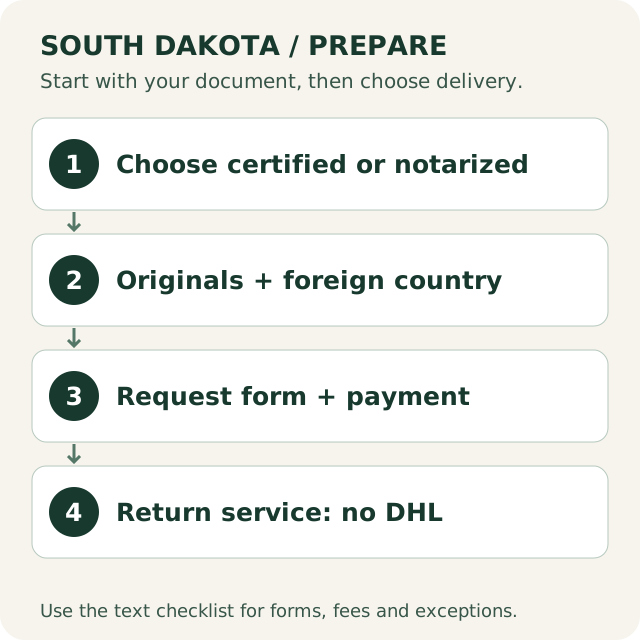
SOS’s default return is untracked standard USPS mail to a U.S. address. For tracking, a different method or any foreign address, enclose a prepaid self-addressed return envelope/label suitable for that service, with a complete deliverable address and enough capacity for the attached certificates. Do not send DHL: the refusal covers incoming and outgoing shipments. The guide does not invent a carrier-account-number alternative or promise every international carrier/destination is available. If overseas return through an accepted carrier is impractical, arrange a reliable U.S. recipient and separate onward delivery. Keep payment details off the outside of the package. A paid receiving/runner service can provide those logistics only under a separately agreed scope; it cannot change state eligibility. [SD-01: Request Requirements and Mail; SD-02: p.1.]
SD-01 source
SD-02 source
Build a realistic timeline
At retrieval on October 26, 2026, SOS publishes mailed processing within 2 business days after receipt and ordinary drop-off most orders in 1-2 business days. These describe state handling, not door-to-door delivery or an unconditional deadline. Add record issuance, notary scheduling, outbound/inbound mail, security/mailroom handling, corrections, holidays, translation and final overseas transit. SDSU’s ordinary paper-transcript estimate alone is 7-10 business days. Appointment same-day effort is conditional, not a guarantee. Keep carrier acceptance scans separate from a label-created event and ask the office about a delayed packet using its delivery date and request details. [SD-01: methods; SD-18: paper estimate. Planning distinctions are practical guidance.]
SD-01 source
SD-18 source
Keep state and federal background documents separate
A South Dakota state-agency response and an FBI Identity History Summary are different records. Request the issuer’s apostille-suitable original certification for a state record; the state SOS cannot authenticate the FBI’s federal signature. Federal public records go to the federal competent authority, ordinarily U.S. Department of State Office of Authentications, using its current instructions and DS-4194. Its checked fee is $20 per document, with a separate federal queue, address and return rules; do not add that payment to South Dakota’s $25 check. Federal court/consular records can have their own competent-authority instructions. A South Dakota notary’s cover statement does not convert a federal record into a state-issued original. [SD-01: federal exclusion; US-01; US-02.]
SD-01 source
US-01 source
US-02 source
Plan translations and packet integrity
Get the recipient’s exact translation requirement, translator qualification and whether translation occurs before or after apostille. A translation affidavit may have its own notarial signature and authentication needs; it does not change the issuing authority of the underlying foreign or federal record. An apostille verifies origin, not translation accuracy. Keep issuer certifications, all pages and the attached apostille together; scan without detaching or replacing pages. No South Dakota anti-fraud paper features or electronic certificate register were independently inspected, so none is promised. For certificate verification use the issuing Apostille Office’s official contact and the certificate number/date/official; a business good-standing verification tool is not an apostille register. [HCCH-01: Arts. 4-5, 7; SD-01; SD-11. Handling/translation planning is practical guidance.]
HCCH-01 source
SD-01 source
SD-11 source
Recover from a missing item or rejection
Before mailing, check original certifications/seals, complete notarial act, country, legible form, correct document count/payment, U.S.-bank restrictions and non-DHL return plan. If SOS returns the request, keep its written reason, reference and all originals; correct only the identified defect through the issuer or responsible notary, and ask the Apostille Office what must accompany resubmission and whether an additional fee is due. A wrongly ordered informational record requires a certified issuer replacement; a notarized copy is no repair. If a foreign recipient refuses a completed packet, get the named approving office’s written reason, required document/version and escalation path before buying a replacement. A casual phone preference is not proof the apostille itself was invalid. Do not detach, modify, backdate or add seals yourself. [SD-01: requirements; SD-05: copy-type warning; HCCH-01: Art. 7. Recovery sequence is practical operating guidance.]
SD-01 source
SD-05 source
HCCH-01 source
Worked case: one birth certificate by mail
Suppose an eligible adult needs their own South Dakota certified birth record for an applicable Convention destination and already has acceptable photo ID. Mail the signed certified-copy application, ID copy and $15 issuer payment to Vital Records. When it arrives, send the intact record with SD-02, destination, return plan and a separate $25 SOS payment to the Capitol Apostille Office. Government record/authentication fees total $40 ($15+$25), plus chosen postage and any translation. Choosing the checked VitalChek regular-mail option instead gives $51.50 ($26.50+$25) before the separate SOS submission/return costs. No extra notarization of the birth certificate is required or permitted as a substitute for issuer certification. [SD-04; SD-05; SD-07; SD-01; SD-02.]
SD-02 source
SD-04 source
SD-05 source
SD-07 source
SD-01 source
SD-02 source
Worked case: mixed business, school and federal packet
Suppose the recipient requires a two-page SOS-certified filing, a properly prepared SDSU transcript and an FBI report. The filed-copy issuer fee is $19 ($15+$2×2), then a $25 South Dakota certificate: $44 for that record before delivery. The transcript starts at $10 plus applicable sales tax and any separately arranged notarization, then another $25 state certificate. The FBI document follows the separate federal route with its current $20 fee. Do not apply the state 10-document cap across unrelated authorities, and do not pay SOS for the FBI report. For one ordinary request containing eleven eligible South Dakota documents, the schedule lists $250 rather than the form’s $275 multiplication; confirm that batch total with SOS. Eleven documents exceeds the expedited appointment limit of ten. [SD-03; SD-12; SD-17; SD-01; US-01. Synthetic arithmetic is not an order quote or acceptance guarantee.]
SD-03 source
SD-12 source
SD-17 source
SD-01 source
US-01 source
Free DIY and the real value of optional help
This guide and the official forms are free to use; official records, notarization where needed, government fees, translations and carriers can still cost money. A complete ordinary packet can be submitted without Notary Geek or another intermediary. A managed service may add document review, coordinating issuer/notary corrections, an appointment/pickup runner when available, receiving records, tracking, scan-back and agreed onward shipment. It cannot issue the state apostille, turn an ineligible record into an original, bypass the appointment limit, guarantee a state queue or guarantee recipient acceptance. Greg Lirette / Notary Geek’s operating distinction is to separate record procurement, lawful act, state handling, scan-back and carrier movement; there is no claim here of an established South Dakota runner network or a tested South Dakota order. [SD-01: agency process; attributed practical guidance, not an official requirement.]
SD-01 source
Check for changes before committing a deadline
Forms, fees, office locations, bank/card restrictions, appointment availability and issuer output can change. These sources were retrieved 2026-10-26; DOH’s order page separately says last updated 2026-09-14, its eligibility/fee pages 2025-01-09, and UJS’s civil fee PDF effective 2026-07-01. An undated SOS form is not described as newly effective. Reopen the official instructions/form immediately before payment and shipping. Report a dated official correction with its URL and affected step; the source archive preserves this retrieval separately from later source updates. [SD-01 to SD-09.]
SD-01 source
SD-09 source